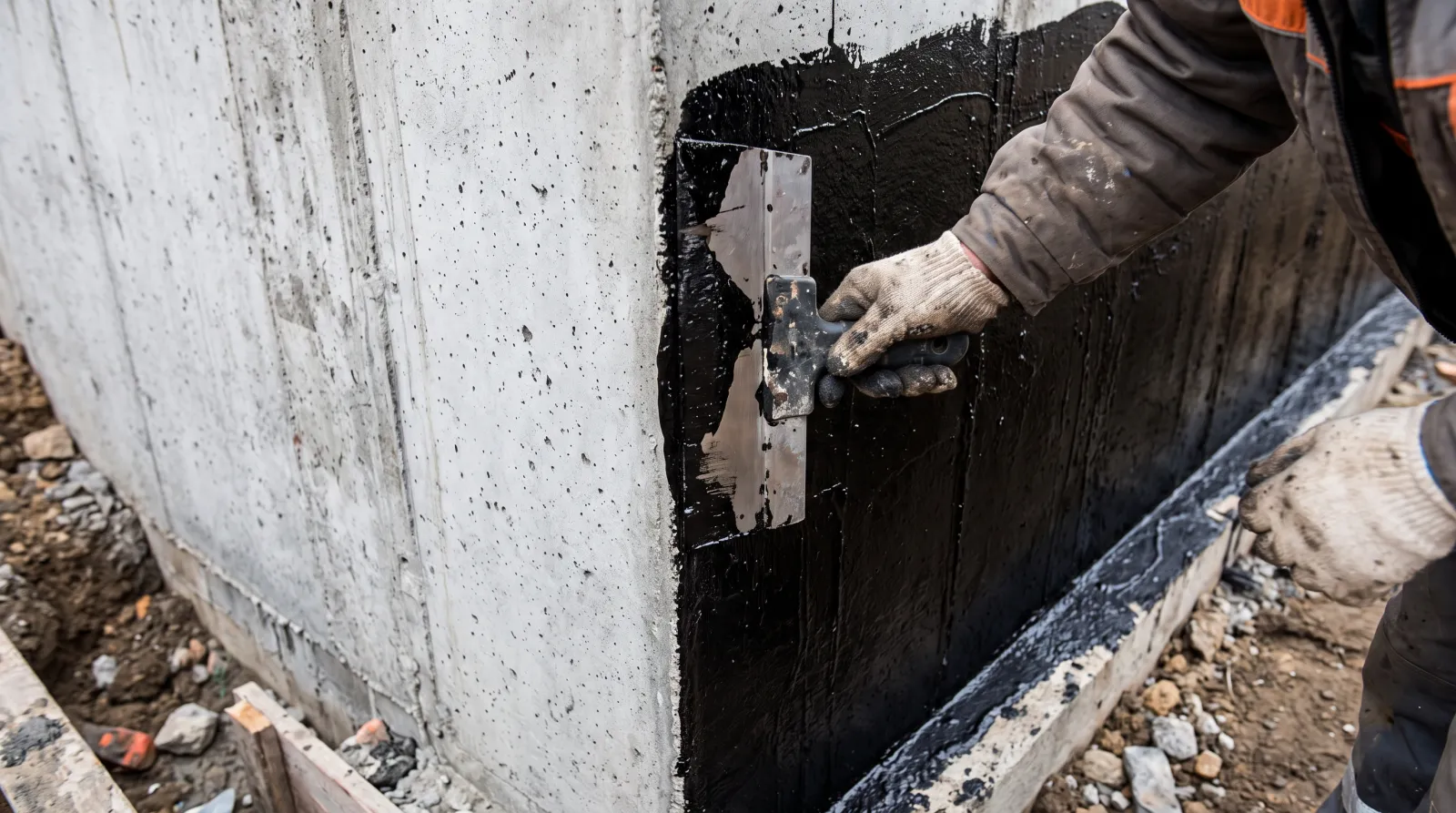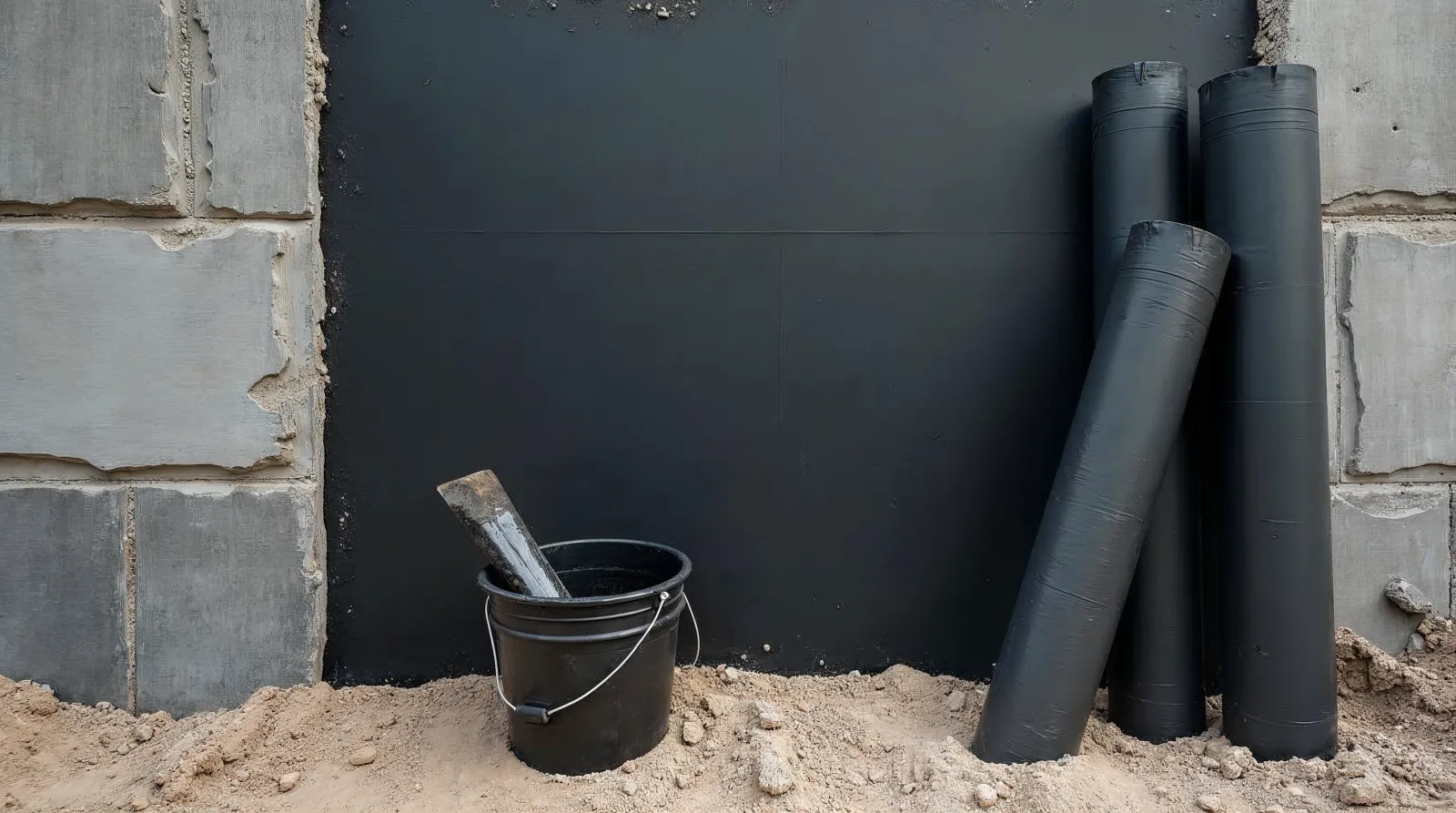
Coated waterproofing is better suited for foundations with complex shapes, corners and pipe entries, and for DIY work. Rolled waterproofing provides a uniform factory thickness of 3–4 mm on large, flat walls, but each overlap must be glued. Below is a table with 7 criteria and a selection rule.
- The coating provides a seamless coating that tightly covers corners, protrusions and pipe entries.
- The mastic is applied in 2–3 layers with an interval of about 8 hours, so the work takes 2–3 days.
- The roll has a factory thickness, but the weak point of the roll system is the overlaps and corners.
- For pressurized water, both options require reinforcement, just 2 layers of mastic are not enough here.
- Technologies combine: roll on flat surfaces, mastic on nodes and inlets.
What is the difference between coating and roll waterproofing?
The difference is in how the coating is formed: the coating hardens on the wall, the roll comes ready-made from the factory. The thickness, number of seams and requirements for the base depend on this.
Coating waterproofing is a bitumen or bitumen-rubber mastic that is applied with a spatula, brush or roller. After drying, the layers merge into one seamless coating. The thickness is determined by the number of layers and the material consumption per 1 m².
Rolled waterproofing is a bitumen-polymer based sheet that is melted with a torch or glued to a primed wall. The sheets are laid with an overlap, so there are always seams on the wall. The typical thickness of the sheet is 3–4 mm.
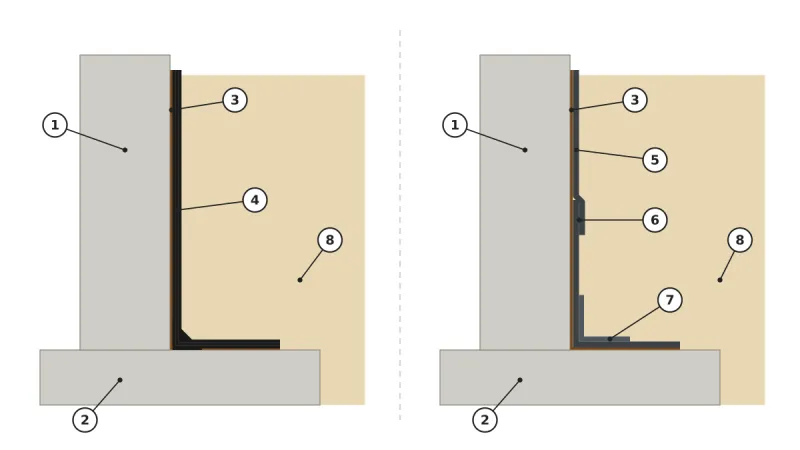
- Concrete foundation wall.
- Foundation slab.
- Bitumen primer.
- Mastic, 2–3 layers without seams.
- Roll canvas.
- Overlap of two canvases.
- Additional strip on the corner.
- Backfill soil.
The general choice of material for the groundwater level is discussed in the article Foundation Waterproofing: How to Choose Materials and Technology . Here we compare only two technologies.
Coating or roll waterproofing: comparison according to 7 criteria
Coating wins on complex knots and in simplicity, roll on uniformity of thickness of large areas. The rest of the criteria depends on the conditions on the site.
| Criterion | Coating | Rolled |
|---|---|---|
| Basis | Dry, primed, tolerates small irregularities | Dry, primed, flat: the canvas does not fit on the protrusions |
| Substrate moisture | Bitumen-rubber mastic is applied only to a dry base. | A dry base is required, otherwise the canvas will peel off. |
| Water pressure | Soil moisture: 2–3 layers; water under pressure: 4 mm reinforced coating | Soil moisture: 1 layer; pressurized water: number of layers according to the design |
| Seams and corners | Seamless coating, corners and pipe entries are closed without cutting | Overlaps at every joint, corners and pipes need to be cut and reinforced |
| Speed | 2–3 layers with a break of about 8 hours | One pass, but slower on corners and inlets |
| Tools and skills | Spatula, brush, roller | Torch and experience for welded rolls; knife and roller for self-adhesive |
| Repair | The damaged area is cleaned and a new layer is applied. | Cut out the damaged area and apply a patch with an overlap. |
Compare the price per 1 m² on your volume: it depends on the number of layers, area and number of corners. On a foundation with many pipe entries, part of the roll savings goes to working with nodes.
When to choose coating waterproofing
Choose a coating if the foundation has many corners, protrusions and utility inlets or if you are doing the work yourself. The mastic fits any shape and does not require a burner.
For soil moisture, a primer and 2–3 layers of bitumen-rubber mastic are sufficient. The first layer is applied at a consumption of 0.8–1.2 kg/m², the subsequent ones at 0.6–0.8 kg/m². The work is carried out at a temperature of +5 to +25 °C.
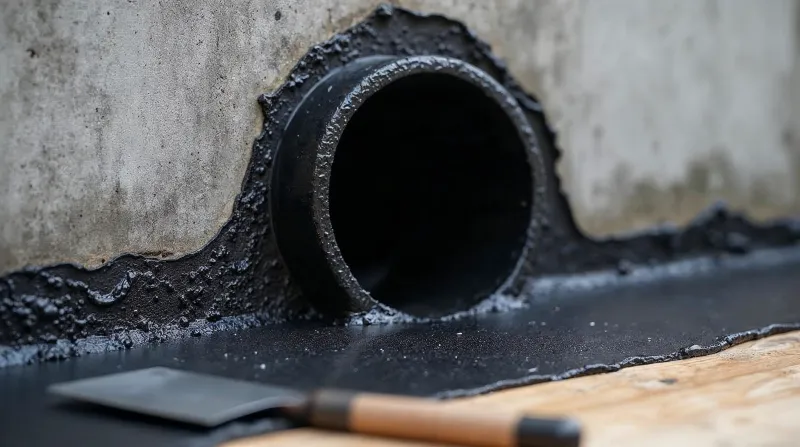
Before applying mastic, the wall is primed with a bitumen primer, for example, Izoplast R primer . How to prepare the base and apply layers in turn is described in the article Bitumen waterproofing of the foundation .
Coating limitations: thickness depends on the accuracy of application. To avoid leaving thin spots, control the consumption: 140–200 kg of mastic is required for 100 m² of wall for 2 layers.
If the foundation is insulated with XPS boards, it is convenient to use a mastic that also works as an adhesive. For example, Izoplast W-KL water-based mastic for waterproofing is used at a consumption of 0.6–1.0 kg/m², and for gluing boards at a consumption of 0.8–1.2 kg/m².
When to choose roll waterproofing
Choose a roll for large, flat walls, when the same thickness across the entire area is important. The canvas comes with a factory thickness, so there will be no thin spots on the surface.
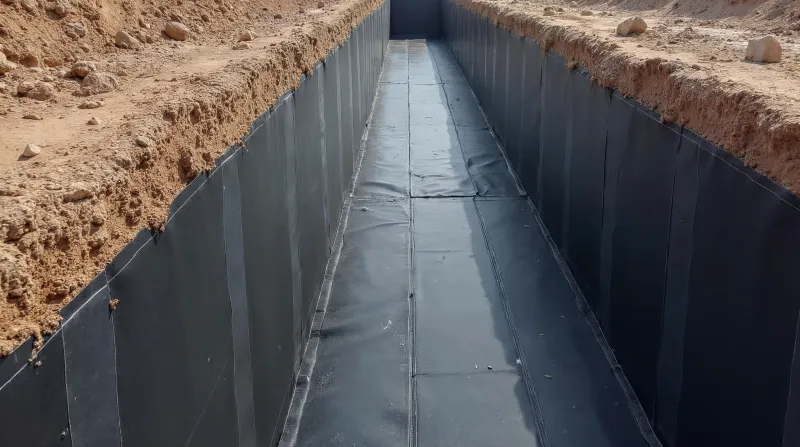
The main risk of a roll system is overlap. A typical overlap is about 10 cm along the length of the sheet and larger at the ends, for exact values, refer to the roll manufacturer's instructions. Every joint and every corner must be glued without gaps.
Protex does not sell rolled materials. If your facility requires rolled waterproofing, check with the roll manufacturer for the sheet parameters and installation method.
Is it possible to combine mastic and a roll?
Yes, and on complex foundations this is often the most practical solution. The roll is laid on a level surface of the walls, and the corners, pipe entries and joints to the slab are sealed with mastic.
The materials must be bitumen-based and compatible with each other. Check the instructions for both materials to see if one can be applied over the other and in what order.
Take special care of the concreting joints between the slab and the wall: neither mastic nor a roll on the outside replaces sealing them from the inside of the concrete. What happens if you skip this and other steps is described in the article about mistakes when waterproofing a foundation .
Typical mistakes when choosing
- They choose a roll for the foundation with a dozen pipe entries. Each entry becomes a place where the sheet needs to be cut and reinforced, and that's where leaks appear.
- Apply mastic in one thick layer instead of 2–3 thinner ones. The layer dries unevenly and can crack.
- They work on wet concrete. Both the mastic and the roll peel off from the wet base.
- The cavity is filled without a protective layer. The crushed stone in the backfill damages both the mastic and the canvas, so a protective membrane is placed before the backfill.
When is mastic enough and when is it worth taking a roll?
Choose a coating waterproofing if the foundation has a complex shape, many pipe entries or you are doing the work yourself. Choose a roll-on waterproofing if the walls are large and even and the installation is carried out by an experienced team. For water under pressure, a reinforced solution is required in both cases.
Send a foundation drawing or a photo of the unit to a Protex technologist. He will select the material and calculate the cost for your facility.
Common questions
Will the mastic withstand if groundwater is nearby?
If the water is below the base and only soil moisture acts on the wall, a primer and 2–3 layers of mastic are enough. If the water is above the base and presses on the wall, a reinforced coating 4 mm thick is required. The water level is determined by geology or a pit in the spring.
Is it possible to combine mastic and roll waterproofing?
Yes. The roll is laid on a level surface, and the corners, pipe entries and joints to the slab are sealed with mastic. Both materials must be bitumen-based, check the compatibility in the instructions for them.
What is easier to do with your own hands?
Coating: it requires a spatula, brush or roller. The welded roll requires a torch and experience, and a mistake on the overlap causes leaks. The mastic dries longer, between layers it is kept for about 8 hours.
How long will the mastic last?
The service life depends on the conditions: the number of layers, the quality of the substrate and whether the coating is protected by a membrane from backfilling. The exact period for a specific material should be checked with a Protex technologist.
Products from this article