Materials for waterproofing the foundation are selected according to how the water acts on the wall: soil moisture, non-pressure water or water under pressure. For soil moisture, a bitumen primer and 2–3 layers of bitumen-rubber mastic are usually enough. For water under pressure, a reinforced coating with a thickness of 4 mm is required, and below is a selection table and calculation per 100 m².
- First, determine the type of water near the foundation: the material and number of layers depend on it.
- The mastic is applied in 2–3 layers on a dry, primed base at a temperature of +5…+25 °C.
- For pressurized water at depths of up to 7 m, 2 layers of emulsion with technical textiles are required.
- 100 m² of wall requires 140–200 kg of mastic in 2 layers, without a reserve.
- Before backfilling, the coating is covered with a protective membrane, and the concreting seams are sealed separately.
What determines the choice of foundation waterproofing
The choice depends on how the water contacts the foundation. There are three scenarios, and each requires a different thickness of coating.
- Soil moisture (capillary): groundwater level below the sole, water rises through the pores of the soil and concrete.
- Non-pressure water: rain and melt water flows along the wall, but does not stand next to it permanently.
- Water under pressure (pressure): the groundwater level is above the sole, the water presses on the wall and slab.
Each meter of water column gives a pressure of about 0.1 bar. If the water is 3 m above the base, the pressure on the bottom of the wall is about 0.3 bar. The water level is taken from geological surveys or checked with a well in the spring, when the water is highest.
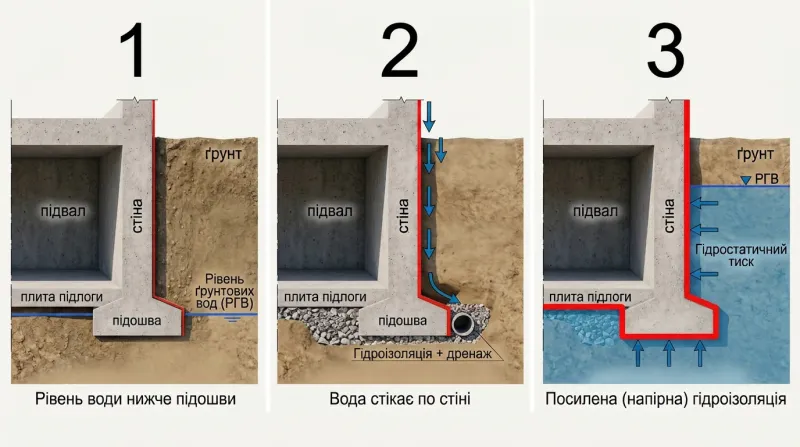
- Basement wall.
- The sole of the foundation.
- Floor slab.
- Waterproofing.
- Groundwater level.
What materials are available for foundation waterproofing?
Three groups of materials are used for external foundation waterproofing: coating, roll and penetrating. They differ in the method of application, requirements for the substrate and the way they cover corners and seams.
Coating waterproofing
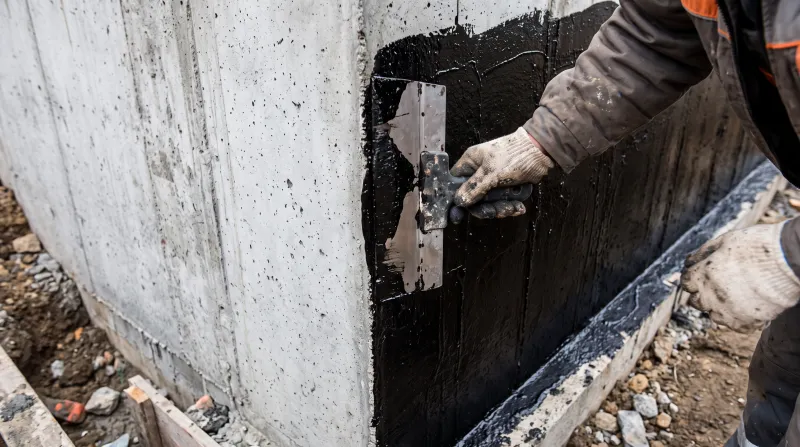
Bitumen mastic or bitumen-polymer emulsion is applied with a spatula, brush or sprayer. The result is a seamless coating that tightly fits corners, protrusions and pipe entries. The mastic consumption is 0.6–1.2 kg/m² per layer.
We have discussed the composition, types and application procedure separately in the article bitumen waterproofing of the foundation .
Rolled waterproofing
Rolls on a bitumen-polymer basis are glued or welded onto a primed wall with an overlap. The coating has a factory thickness, but each overlap and corner must be carefully glued. A typical sheet has a thickness of 3–4 mm, and the overlap is at least 100 mm along the sheet and 150 mm at the ends.
Protex does not sell rolled materials, so check the exact parameters with the roll manufacturer.
Penetrating waterproofing
The penetrating compound is applied to wet concrete, and its active components fill the pores and capillaries. The compound works only on concrete, but it can also be applied from inside the basement. Most compounds close cracks up to 0.4 mm wide, wider cracks and seams are sealed separately.
Protex does not sell penetrating compounds.
Table: groundwater type and solution
The more water pressure is on the wall, the thicker the coating should be: from 2-3 layers of mastic to 4 mm with reinforcement. The table below shows the minimum set for each scenario.
| Water type | Signs on the site | Wall covering | Thickness or consumption | Additionally |
|---|---|---|---|---|
| Soil moisture | The water level is below the sole, the pit is dry even in spring | Bitumen primer and bitumen-rubber mastic, 2–3 layers | 1st layer 0.8–1.2 kg/m², subsequent layers 0.6–0.8 kg/m² | Protective membrane before backfilling |
| Non-pressure water | Water appears after rains and melting snow, but does not stand still. | Bitumen-polymer emulsion, 1 or 2 layers | 1 layer 2 mm ≈2.5 kg/m² or 2 layers 4 mm ≈4.5 kg/m² | Protective membrane, seam sealing |
| Water under pressure | The water level is above the sole, there is standing water in the pit | Bitumen-polymer emulsion, 2 layers with technical textiles | 4 mm ≈4.5 kg/m², depth up to 7 m | Protective membrane, seam sealing |
For non-pressure water, the number of layers depends on how long the water sits on the wall after rain. If in doubt, choose 2 layers of 4 mm.
For water under pressure, a coating is required that is reinforced with technical textiles and applied in a total layer of 4 mm. Such a system is provided, for example, by the two-component bitumen-polymer emulsion Izoplast 2K-W .
If the foundation is buried in the water table by more than 7 m , the data from the material card does not cover this case. The solution for this is selected by the technologist according to the project.
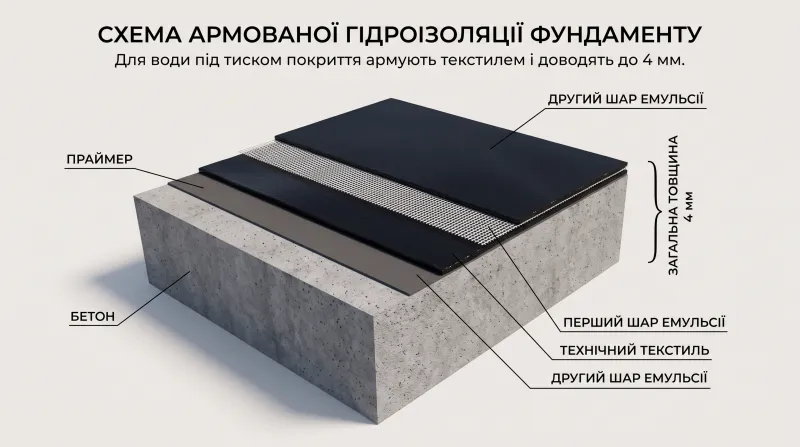
- Concrete.
- Priming the base, if required by the emulsion instructions.
- The first layer of emulsion.
- Technical textiles.
- Second layer of emulsion.
- Total coating thickness: 4 mm.
How much material to take per 100 m²
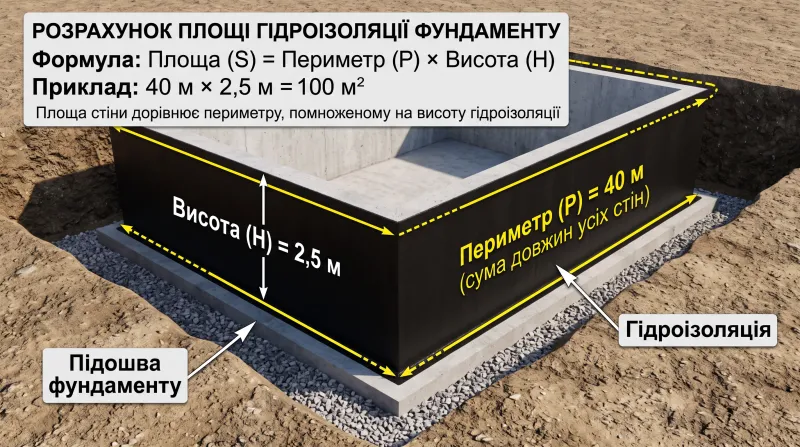
For 100 m² of wall, you need 140–200 kg of bitumen-rubber mastic in 2 layers and 30–60 kg of primer for the first layer. Calculate the area as the perimeter of the foundation multiplied by the height of the waterproofing: 40 m × 2.5 m = 100 m².
| Material and scheme | Norm | Per 100 m² | Packaging |
|---|---|---|---|
| Primer, 1 coat | 0.3–0.6 kg/m² | 30–60 kg | 2–3 buckets of 20 kg each |
| Mastic, 2 layers | 1.4–2.0 kg/m² | 140–200 kg | 6–9 buckets of 24 kg each |
| Mastic, 3 layers | 2.0–2.8 kg/m² | 200–280 kg | 9–12 buckets of 24 kg |
| Emulsion, 1 layer 2 mm | ≈2.5 kg/m² | ≈250 kg | 8 packages of 32 kg each |
| Emulsion, 2 layers 4 mm | ≈4.5 kg/m² | ≈450 kg | 15 packages of 32 kg |
The standards are taken from product cards, for example, bitumen-rubber mastic Izoplast B in 24 kg buckets. The calculation is given without allowance for corners, protrusions and uneven base.
The waterproofing is brought out at least 30 cm above the ground level during construction. After planning the site, at least 15 cm of coverage should remain above the ground.
How to apply coating waterproofing: work procedure
The coating is applied in dry weather at a temperature of +5…+25 °C on a clean, dry base. The procedure is as follows.
- Clean the wall from soil, dust and concrete overflows, let the base dry.
- Apply bitumen primer: 0.3–0.6 kg/m² on the first layer, wait up to 6 hours before applying the next layer.
- Apply 2–3 coats of mastic: the first 0.8–1.2 kg/m², the next 0.6–0.8 kg/m², with an interval of about 8 hours.
- Work around corners, pipe entries and protrusions with an additional layer.
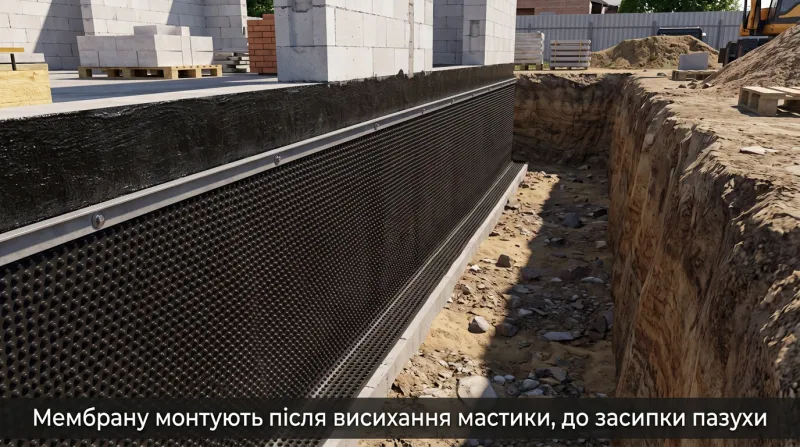
- After drying, cover the coating with a protective membrane and only then fill the sinus.
Do not replace the primer with a primer for interior work. We explain the difference in the article Bitumen primer or deep penetration primer .
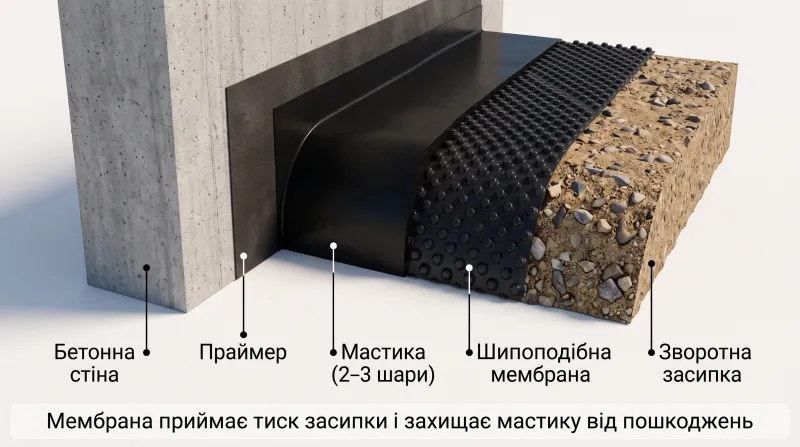
- Concrete wall.
- Primer.
- Mastic, 2–3 layers.
- Spiny membrane.
- Backfill.
A protective layer is needed because stones and gravel in the backfill will damage the mastic. For this, a spiked membrane is used, for example a drainage membrane with a density of 500 g/m² in a 2×20 m roll .
Common mistakes: applying mastic to wet concrete, skipping primer, or filling in the cavity without a membrane. The coating then peels or tears, allowing water to find its way into the wall.
How to protect concreting joints
Concreting seams are closed during pouring: with bentonite cord or hydraulic dowel. A concreting seam (cold seam) occurs where concrete was poured at different times, for example between a slab and a wall.
Bentonite cord (also called a bundle) is placed on the first layer of concrete. In water, the cord swells up to 400% and seals the joint from the inside. A waterstop is a PVC profile that is poured into the concrete on both sides of the joint.
A comparison of the two solutions in terms of price, installation, and operating conditions is provided in the article Bentonite bundle or hydro-key for cold joints .
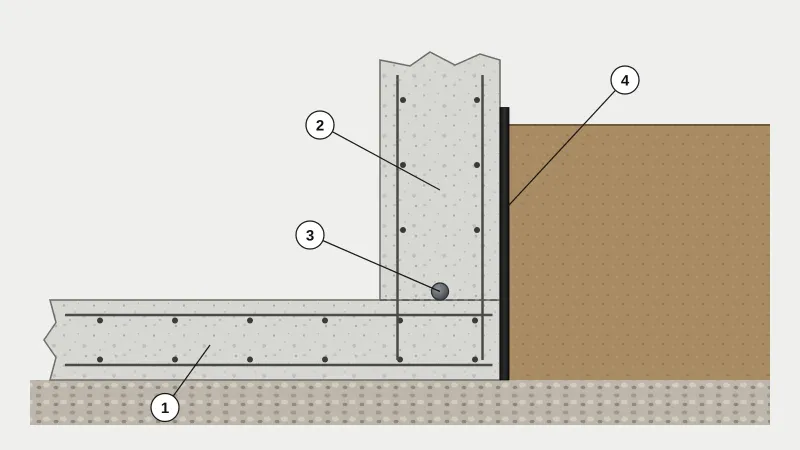
- Foundation slab.
- Wall poured after the slab.
- Bentonite cord in the seam.
- External waterproofing (mastic).
What to choose for your foundation
Choose a primer and 2–3 layers of bitumen-rubber mastic if the groundwater is below the base and the wall is only threatened by soil moisture. Choose a 4 mm reinforced coating, membrane and joint sealing if the water is above the base. Consider a penetrating compound if the wall cannot be reached from the outside.
Send a foundation drawing or a photo of the unit to a Protex technologist. He will select the materials and calculate the cost for your facility.
Common questions
What is better for the foundation - coating or roll?
Depends on the type of water and the shape of the foundation. The coating gives a seamless coating and fits tightly around corners and pipe entries. The roll has a factory thickness, but each overlap must be carefully glued.
How many layers of mastic are needed?
2–3 coats on a primed, dry base. First coat 0.8–1.2 kg/m², subsequent coats 0.6–0.8 kg/m², approximately 8 hours between coats.
Can it be applied to wet concrete?
No: bitumen-rubber mastic is applied to a dry, primed surface at +5…+25 °C. For other materials, see the application conditions in their instructions.
How to protect mastic before backfilling?
Spiked membrane: it is installed after the mastic has dried, before backfilling. Without it, stones and gravel in the backfill will damage the coating.
Скільки матеріалу брати на 100 м²?
For 2 layers of mastic 140–200 kg (6–9 buckets of 24 kg) and 30–60 kg of primer. For a reinforced coating of 4 mm ≈450 kg of emulsion. This is without a margin for corners and irregularities.
Products from this article