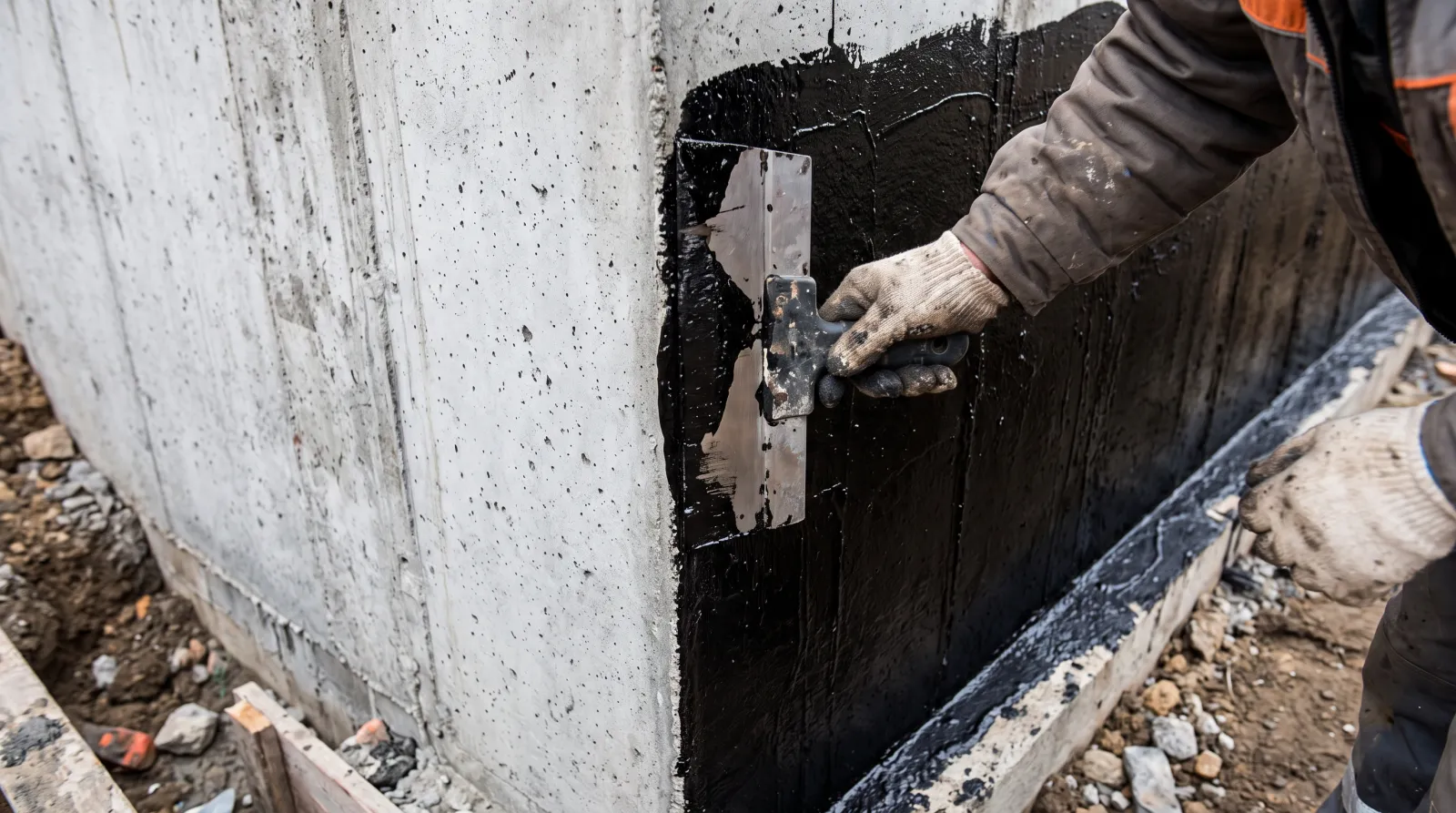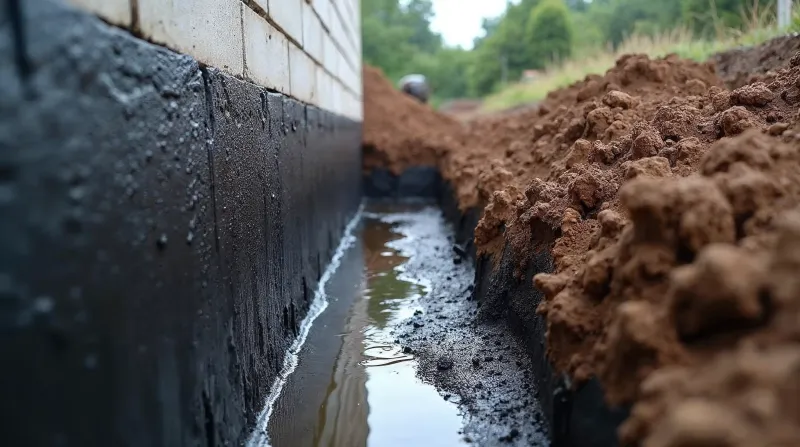
Groundwater waterproofing is selected based on the water level relative to the base of the foundation. If the water is below the base, a primer and 2–3 layers of bitumen-rubber mastic are sufficient. If the water is above the base, it presses on the wall with a force of about 0.1 bar per meter of depth, and a 4 mm reinforced coating, joint sealing and a protective membrane are required.
- First, find out the groundwater level from geology or a pit dug in the spring.
- For soil moisture, a primer and 2–3 layers of mastic on a dry base are sufficient.
- For non-pressure water, 2 layers of 4 mm emulsion are used and the water is drained away by drainage.
- For water under pressure, the coating is reinforced with textiles and adjusted to 4 mm.
- The seam between the slab and the wall is sealed separately at any water level.
How to find out the groundwater level on the site
The groundwater level is taken from the geological survey report, and without a report, it is checked with a pit in the spring. The groundwater level (GWL) is the depth at which free water stands in the soil. It rises the highest in the spring, so the summer measurement gives an optimistic picture.
- Find the RGV and its seasonal variation in the geologists' report.
- If there is no report, dig a hole just below the future sole and check to see if water appears in it.
- Compare the water level with the mark on the base of the foundation.
- Calculate the pressure: each meter of water above the sole gives about 0.1 bar.
Example: the water is 3 m above the base, so the pressure on the bottom of the wall is approximately 0.3 bar. This figure determines which coating and joint sealing will withstand the load.
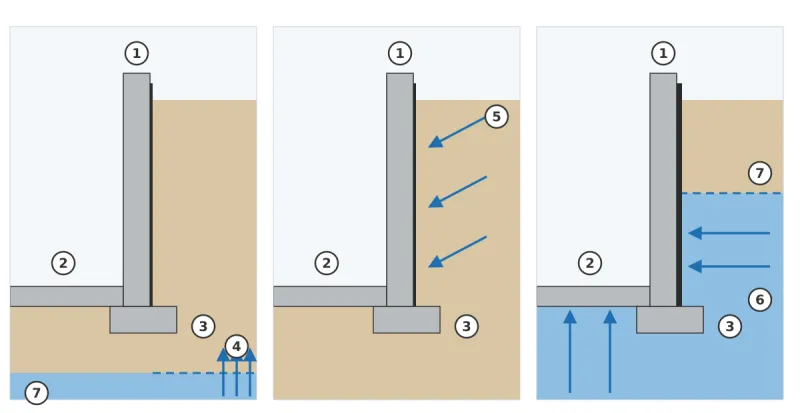
- Basement wall.
- Floor slab.
- The sole of the foundation.
- Capillary moisture rises from groundwater.
- Rain and melt water flows along the wall.
- Water under pressure acts on the wall and the slab.
- Groundwater level.
Three scenarios: what is the difference between soil moisture, non-pressure and pressure water
The scenario determines the position of the water relative to the sole: lower, periodically near the wall, or constantly higher. The higher the water is, the thicker the coating should be and the more thoroughly the seams should be sealed.
| Criterion | Soil moisture | Non-pressure water | Water under pressure |
|---|---|---|---|
| Water level | Below the sole even in spring | Appears after rains and melting snow, but does not stand permanently | Above the sole, there is water in the pit |
| How water works | Rises through the pores of soil and concrete | Flows along the wall | Presses against the wall and the stove |
| Pressure on the bottom of the wall | None | Short-term, while the water stands near the wall | About 0.1 bar for every meter of water above the sole |
| Wall covering | Primer and 2–3 layers of bitumen-rubber mastic | Bitumen-polymer emulsion: 1 layer 2 mm or 2 layers 4 mm | 2 layers of emulsion with technical textile, 4 mm |
| Seam between the slab and the wall | Sealed separately | Sealed separately | Sealed with a system designed for water pressure |
| Drainage and protection | Protective membrane before backfilling | Drainage membrane and drainage pipe | Protective membrane, drainage according to the project |
We discussed the consumption of mastic per 100 m² and the order of applying layers in the article Foundation waterproofing: how to choose materials and technology . Here we will focus on how the water level changes the solution.
Waterproofing from groundwater when the water is below the sole
When the water is below the base, only the soil moisture acts on the wall, and a primer and 2–3 layers of bitumen-rubber mastic are enough. The first layer is applied at a consumption of 0.8–1.2 kg/m², the subsequent ones at 0.6–0.8 kg/m². The work is carried out in dry weather at a temperature of +5…+25 °C.
Mastic is applied only to a dry, primed base. Corners, pipe entries and joints to the slab are covered with an additional layer. After the coating dries, it is covered with a protective membrane, otherwise the crushed stone in the backfill will damage the mastic.
If the water is at the level of the sole , do not rely only on mastic. In the spring, the water may rise higher, and then it will start to put pressure on the wall. Choose a solution for both non-pressure or pressure water and clarify it with the technologist.
What to do with non-pressure water: coating and drainage
For non-pressure water, apply 2 layers of bitumen-polymer emulsion with a total thickness of 4 mm and drain the water away from the wall with a drain. A 1-layer 2 mm emulsion is only suitable if the water drains quickly after rain. If in doubt, apply 2 layers.
The drainage membrane with geotextile consists of a studded high-density polyethylene fabric and a layer of geotextile. Channels are formed between the studs, through which water flows down, and the geotextile prevents the soil from silting them. The membrane relieves hydrostatic pressure from the waterproofing and drains the water into the drainage pipe.
The membrane is placed with the geotextile to the ground, and the lower edge is brought to the drainage pipe. For this, for example, the drainage membrane with geotextile SNTDrain 550+150 g/m² is suitable. How such a material works and where it is also used is described in the article about the spiked membrane with geotextile .
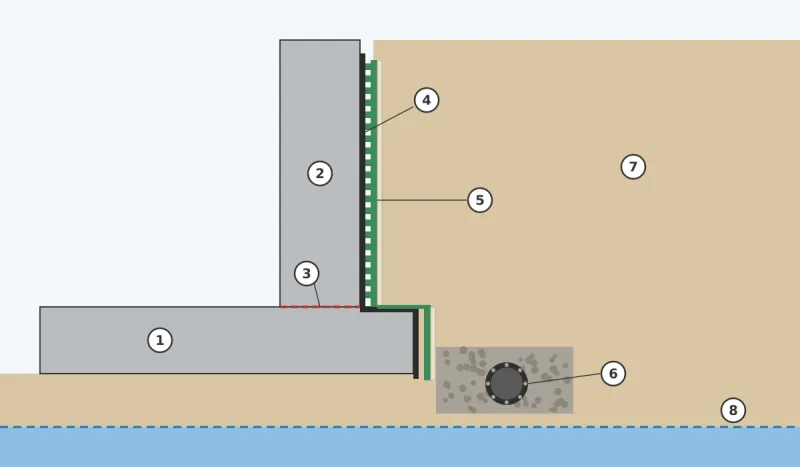
- Foundation slab.
- Basement wall.
- Concreting seam between the slab and the wall.
- Waterproofing coating.
- Drainage membrane, geotextile to the soil.
- Drainage pipe in crushed stone bedding.
- Backfill.
- Groundwater level.
Whether drainage is needed in a specific area is decided by the project. The water from the pipe needs to be diverted somewhere, so the route and discharge point are thought out even before backfilling.
Water above the sole: which coating will withstand the pressure
For water under pressure, a reinforced coating of 4 mm thickness is required: 2 layers of bitumen-polymer emulsion with technical textiles between them. The consumption is about 4.5 kg/m² of dry coating, for 100 m² of wall this is about 450 kg.
Such a system is provided, for example, by the two-component bitumen-polymer emulsion Izoplast 2K-W . According to the material card, it is designed for water under pressure at depths of up to 7 m.
- Prepare a dry, clean surface and prime it if the instructions require it.
- Apply the first layer of emulsion.
- Dip the technical textile into the fresh layer without wrinkles.
- Apply a second layer and bring the total thickness to 4 mm.
- After drying, cover the coating with a protective membrane.
If the foundation is more than 7 m deep in water, the data from the map does not cover this case. The solution for this is selected by the technologist according to the project.
How to protect the seam between the slab and the wall
The joint between the slab and the wall is sealed separately because the exterior coating does not cover it inside the concrete. A concreting joint (also called a cold joint) occurs where the concrete was poured at different times.
For high water pressure, external PVC hydroplugs are used, which are poured into the concrete on both sides of the joint. Another option is a system with an EPDM membrane and glue, for example, the ProElast 1.5 mm EPDM membrane, 200 mm wide . According to the manufacturer, the system works from soil moisture to pressurized water at a pressure of up to 2 bar, which is 20 m of water column.
If the foundation is already filled and the joint is leaking, do not install a waterstop in it. What solutions work in this case is described in the article Waterproofing Joints When the Foundation Is Already Filled .
Rule of 0.1 bar per meter of water
Choose primer and 2-3 layers of mastic if the water is below the sole even in spring. Choose 2 layers of 4 mm emulsion and a drainage membrane if the water comes after rains and goes away. Choose a 4 mm reinforced coating, separate seam sealing and a protective membrane if the water is above the sole: each meter of it adds about 0.1 bar.
Send foundation drawings, geology data, or photos of the unit to a Protex technologist. He will select materials based on the water level on your site.
Common questions
Вода стоїть на рівні підошви: чи вистачить мастики?
Краще не розраховувати лише на мастику. Навесні вода може піднятися вище підошви і почати тиснути на стіну. Обирайте рішення як для безнапірної або напірної води і уточніть рівень у геологів.
Чи обов’язковий дренаж?
Ні, не в кожному випадку. Для вологи ґрунту зазвичай вистачає захисної мембрани перед засипкою. Дренаж відводить воду від стіни і знімає тиск з гідроізоляції, а його потребу визначає проєкт.
Що робити зі швом між плитою і стіною?
Герметизувати окремо: зовнішнє покриття не закриває шов усередині бетону. Для тиску води застосовують зовнішні ПВХ-гідрошпонки або систему з EPDM-мембраною, яка за даними виробника працює при тиску до 2 бар.
Підвал уже мокрий: чи можна виправити ззовні?
Так, якщо до стіни можна докопатися. Стіну відкопують, очищують, просушують і наносять покриття під тип води на ділянці. Шви, які вже протікають, ремонтують окремо, наприклад ремонтними гідрошпонками.
Products from this article


-1_217_1776339177.jpeg)
__1790325580.png)