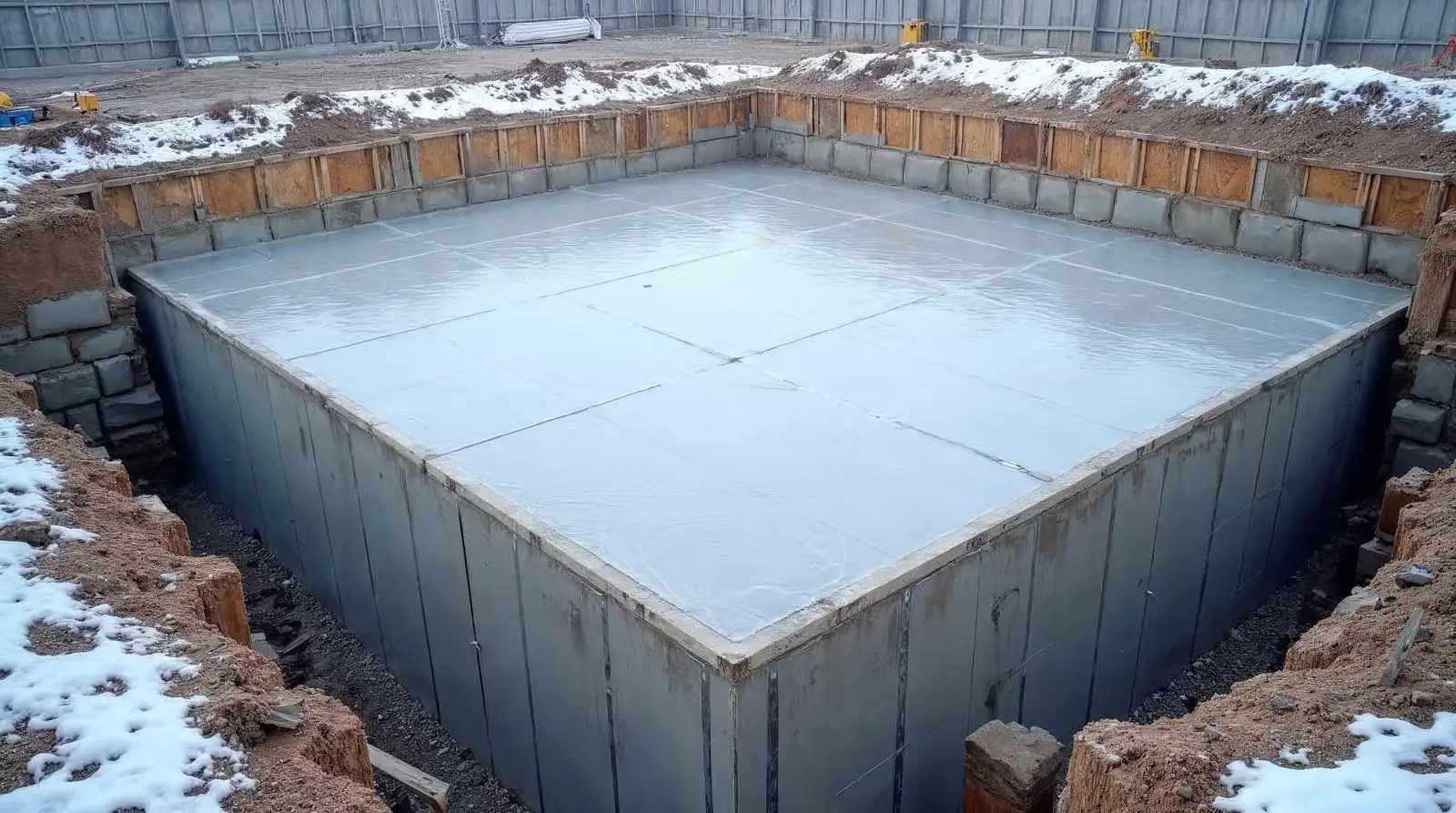
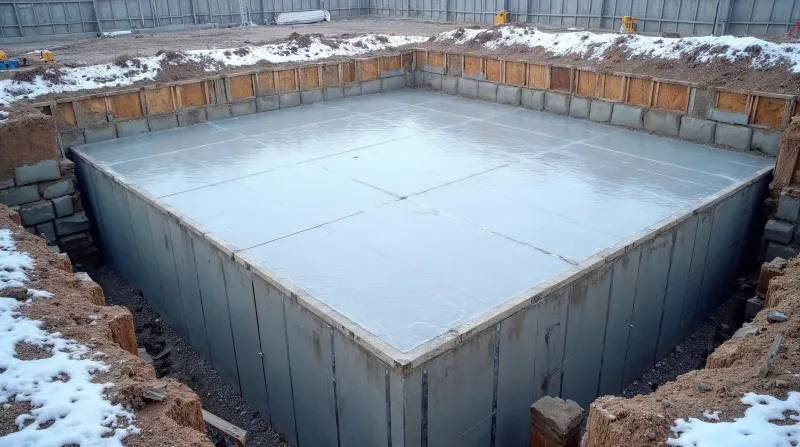
How to pour concrete in winter: the main thing is not to let the water in the concrete freeze while it is gaining strength. At +20 °C, concrete gains about 70% of its strength in a week, and at +5 °C this stage is stretched for 3–4 weeks. Therefore, concrete is protected in winter in three ways: with an antifreeze additive, shelter and heating.
- Do not place concrete on frozen ground, ice or snow: first clean the pit and formwork.
- The antifreeze additive is dosed as a percentage of the cement mass according to the manufacturer's instructions, not by eye.
- For formwork in cold weather, use winter lubricant: summer lubricant is designed for operation from +5 °C.
- Construction film saves in frosts down to −3 °C, below that, a mat or insulation is needed.
- The heat gun is placed under cover on the frame, rather than pointed directly at the concrete.
How to pour concrete in winter and why frost is dangerous
In winter, concrete is poured so that the water in it does not freeze before it reaches strength. Cement needs water for hydration, which is the chemical reaction in which cement hardens. Frozen water does not react and expands in the pores.
Cold slows down hardening already at 0…+10 °C. At normal temperatures of about +20…+25 °C, concrete gains its brand strength in 28 days, and in cold weather this period increases to 35–38 days. Check with a technologist or laboratory for the exact strength gain schedule for your brand of concrete.
Below are 5 common mistakes a foreman makes in winter and what to do instead. At the end of the article there is a short 10-point checklist that is convenient to print out for the facility.
Mistake 1: Pouring concrete on a frozen base
Concrete should not be placed on a frozen base covered with ice or snow. A base with a temperature below 0 °C draws heat from the bottom layer of concrete, and that is where the water freezes first.
How to do it correctly:
- Remove snow and ice from the pit, reinforcement, and fasteners.
- Check whether the base is frozen: if so, it is warmed up before concreting.
- Cover the prepared base with plastic wrap if the concrete is not delivered immediately.
The technologist or project decides how and to what temperature to heat the base at your facility.
Mistake 2: adding antifreeze additive at random
The antifreeze additive is added as a percentage of the cement mass, and the amount depends on the concrete grade and air temperature. The additive lowers the freezing point of water in the mixture and accelerates the set strength, but only within the limits for which it was calculated by the manufacturer.
For example, the antifreeze additive NITCAL S 45, according to the manufacturer, works in the range from +5 to −25 °C. It also reduces the amount of water in the mixture to 10% without changing the consistency. How this additive works and where it is used is described in the article about the antifreeze plasticizer NITCAL S45 .
Refer to the additive instructions for the exact dosage and discuss with the concrete supplier. If the additive is added at the factory, do not add it again at the site.
Mistake 3: Lubricate the formwork with summer grease
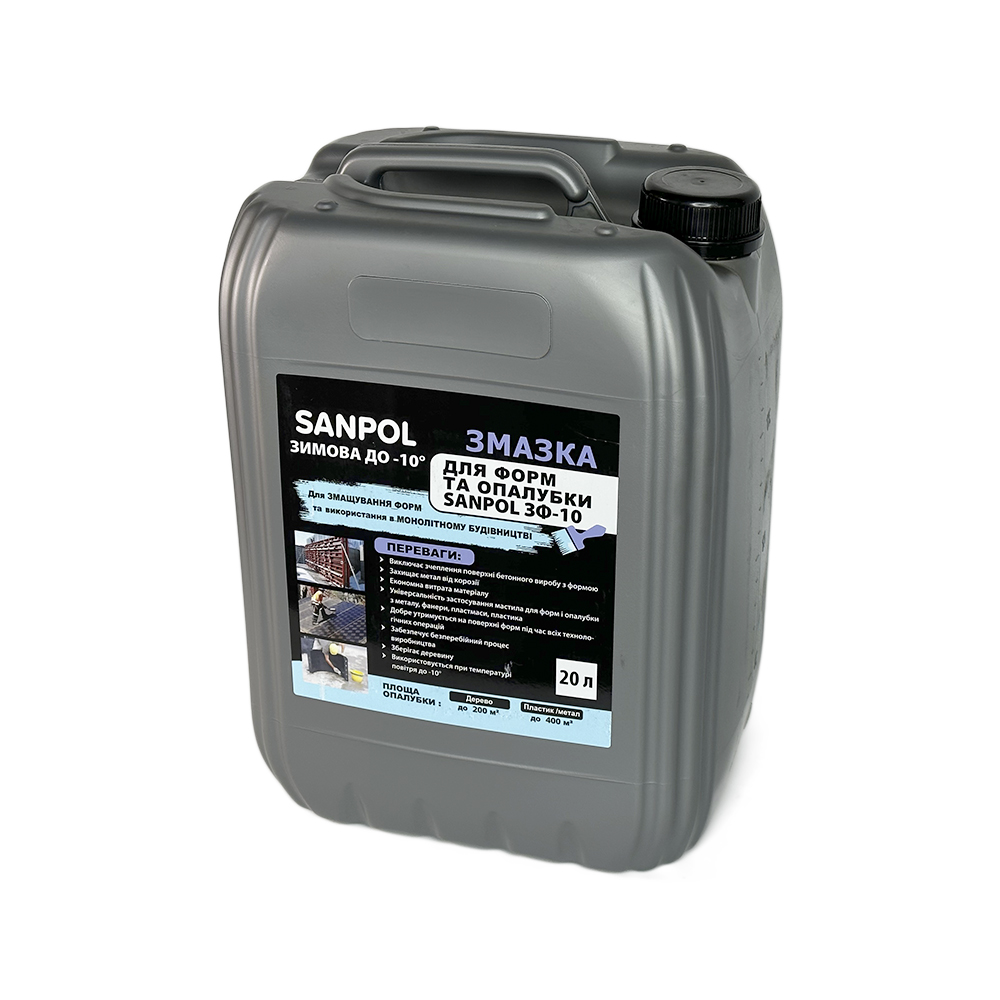
In cold weather, formwork is treated with winter grease, because summer grease is designed to work at positive temperatures. For example, according to the product card, summer grease ZAP-11 is used from +5 to +80 °C.
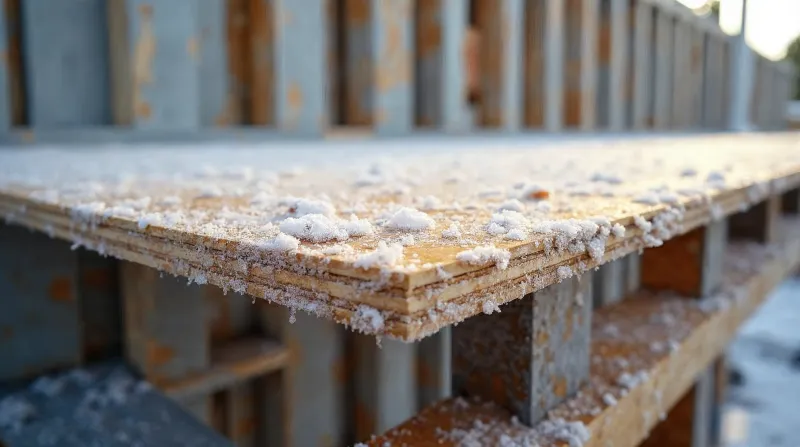
The second mistake here is to apply grease to a board with frost. First, the formwork is cleaned of snow and ice, and only then is it treated.
For winter work, for example, winter formwork lubricant ZF-10 is suitable. The consumption of the working solution is 1 liter per 20–40 m² of wooden surface and 1 liter per 65–80 m² of plastic or metal. For more information about winter lubricant, read the article winter formwork lubricant at sub-zero temperatures .
Mistake 4: Cover concrete with only a thin film in severe frost
The film retains the heat of the concrete in frosts down to about −3 °C, and in severe frosts it is supplemented with mats or a warm blanket, i.e. a film cover on a heated frame. The cover works due to the heat that the concrete itself releases during cement hydration.
| Protection method | When to use | Feature |
|---|---|---|
| Construction film | Frost down to about −3 °C | Protects against wind and water evaporation |
| Thermal insulation mats | About −3…+3 °C | Three-layer: tarpaulin, foamed polyethylene, 150 μm film |
| Hotbed with heat gun | Severe frost, thin structures | Film on frame, air gap above concrete |
| Antifreeze additive | Together with shelter | Temperature range according to additive instructions |
For shelter, take a dense film, for example, 200 μm polyethylene construction film in a roll of 150 m². The film is placed immediately after pouring and pressed along the edges so that the wind does not blow cold under it. What other materials are suitable, is discussed in the article How to cover concrete in winter .
Mistake 5: Blowing a heat gun directly onto the concrete
The heat gun is placed under a film cover stretched over the temporary frame, rather than directed at the concrete surface. This allows the warm air to spread evenly over the structure, accelerating the set of strength.

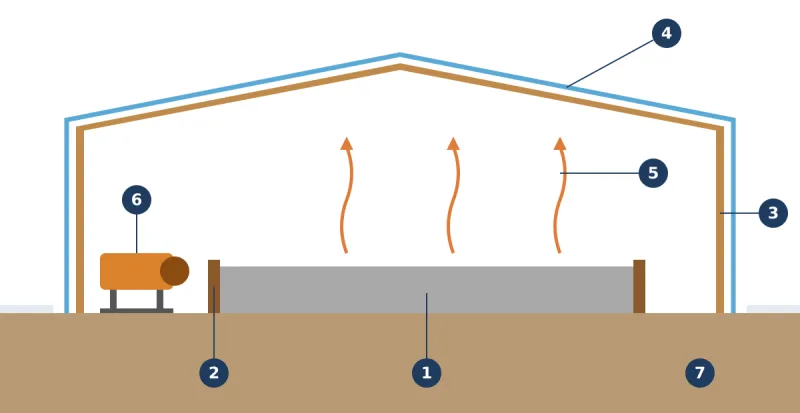
- Fresh concrete.
- Decking.
- Temporary frame.
- Film on the frame.
- Warm air in the gap above the concrete.
- Heat gun.
- Base cleared of snow and ice.
The shelter is not removed immediately after the gun is turned off. How long to keep the shelter and when to remove the formwork depends on the brand of concrete, temperature, and achieved strength, so these terms are agreed with the technologist.
Check these 10 points before pouring
Choose a film shelter if the forecast is not lower than −3 °C. Choose the additive together with mats or a warming mat if the frost is stronger. Before concreting, go through the list:
- The pit, fittings and clamps are cleared of snow and ice.
- The base is not frozen or has been warmed up according to the technologist's decision.
- The 7-day temperature forecast has been checked.
- The antifreeze additive was selected for this forecast.
- The dosage of the additive is agreed with the concrete supplier.
- The formwork was cleaned of frost and lubricated with winter grease.
- The 200 micron film and the mat are lying on the object before the mixer arrives.
- For severe frost, a warm-up frame and a heat gun are ready.
- It is known who will control the temperature of the concrete and how.
- The holding and demoulding times are agreed with the technologist.
Send a Protex technologist a description of the structure, concrete grade, and weather forecast. He will help you choose the admixture, lubricant, and cover for your facility.
Common questions
Up to what temperature can concrete be poured without heating?
Under the film, concrete retains its own heat to approximately −3 °C, with mats about −3…+3 °C. In severe frosts, an antifreeze additive in its operating range and a shelter or a greenhouse are required. Check with a technologist for the exact limit for your structure.
How long to keep the shelter?
Before concrete sets to the required strength. In winter, the brand strength is reached in 35–38 days instead of 28, and at +5 °C the first stage of setting is extended by 3–4 weeks. Agree on the specific time with the technologist based on the brand of concrete and temperature.
Is it possible to pour on a frozen base?
No. Concrete is not placed on a frozen base, ice or snow: the base takes heat from the lower layer, and the water there freezes first. The pit is cleaned, and the base is warmed if necessary.
When to remove formwork in winter?
After the concrete has gained sufficient strength for demoulding, and not earlier than the technologist agrees. In winter, this period is longer than in summer, because the cold slows down the hardening.
Products from this article