



Sealant or PVC sheath: how to fill control joints in an industrial concrete floor without downtime
_224_1781872840.png)
Industrial flooring is a high-strength coating designed for extreme loads, intensive movement of equipment and the influence of temperature fluctuations. And to prevent its destruction, engineers have come up with a simple and ingenious solution — control joints. Most often, they are made by the «cutting» method 12–24 hours after pouring concrete (earlier in summer, later in winter). The concrete must already gain initial strength so that the edges of the joint do not crumble under the disk, but not yet have time to give the first shrinkage cracks. Such joints begin to be cut if the area of a solid concrete screed or floor exceeds 20 sq. m.
The best choice for sealing most control joints is considered to be the classic «foamed cord + sealant» technology (more details about this method), but today we propose to consider a unique alternative: the express method using a Protex PVC sheath («herringbone»). This technology is a mechanical way of filling the joint space.
.png)
If your facility is a logistics complex, dry warehouse, parking lot, sales hall, or production hangar, then the PVC sheath from Protex Ukraine is the best way to deliver the floor on time, without technological downtime, and with minimal cost per linear meter.
Pros: The seam is sealed with a PVC sheath «herringbone» immediately after the seam cutter passes through. There is no need to wait a month, blow out dust, or buy expensive primers. This greatly speeds up the commissioning of the facility. In addition, it is much cheaper than sealant.
Cons: Less elastic compared to pure polyurethane. If the temperature fluctuations on the object are too harsh (for example, an open ramp or a freezer), the seam will spread too much and the «herringbone» may fall out or lose density.
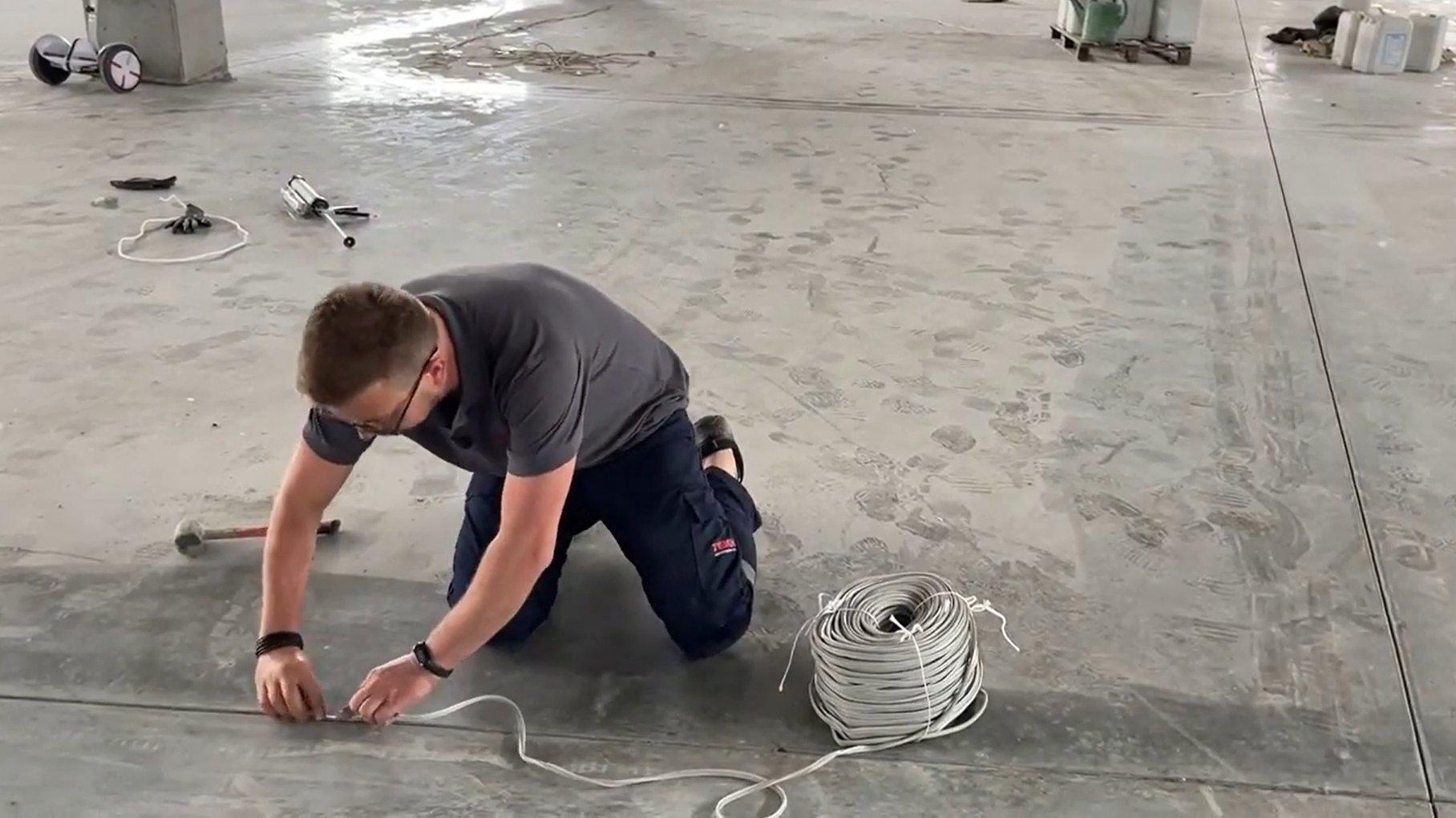
Installation technology:
Quick start: Installation can be performed immediately after cutting the technological joints (2-3 days after pouring the concrete), without waiting a month for the floor to dry.
Pressing: The sheath is laid with the ribs down and rolled in with a roller. It is forbidden to pull the sheath during laying, otherwise it will compress over time and pop out at the joints.
Finish: The sheath is buried flush with the floor or 1 mm below.
What to choose for your object?
Choose «Foam Cord + Sealant» if:
1. The object is located outside, under the open sky (strong temperature fluctuations winter/summer).
2. These are rooms with constant high humidity, where absolute waterproofing of joints is critical (car washes, food processing plants).
3. You have 28 days of technological break after pouring the concrete.
Choose the Protex PVC sheath «herringbone» if:
1. This is a closed warehouse, hangar, workshop or shopping center with a relatively stable microclimate.
2. The terms «burn» and the floor needs to be exploited as soon as possible.
3. The task is to save as much as possible the budget for sealing without losing the primary protection of the floor.
4. Intensive movement of equipment with small hard wheels (rollers, loaders) is planned on the floor — the «herringbone» will protect the edges of the concrete from chips better than a soft sealant.
